
Already in 1949, the first year Andy Warhol worked a s a commercial illustrator in New York, he received commissions for record cover art. He did spot drawings for at least two LP’s on the Columbia label (Carlos Chávez, A Program of Mexican Music and Prokofiev, Alexander Nevsky), both released in 1949.You can hardly call these rare, though, as they regularly turn up for sale, at fairly low prices. This is not the case for a commission Warhol received from the NBC radio station that same year: cover drawings for promotional boxes for radio shows, that were sent to companies in the first months of 1950. Only two titles have surfaced so far: the radio play Night Beat (three known copies) and the news show Voices and Events (one known copy). These are the rarest of all Warhol record covers.
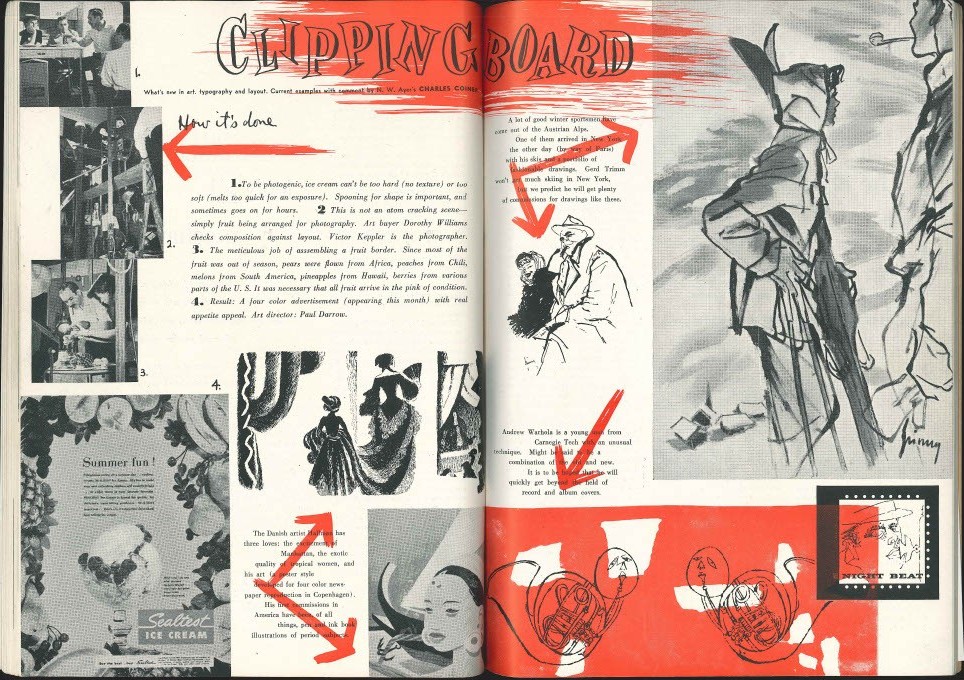
The Night Beat cover is probably the first record cover drawing by Warhol that was printed in a magazine, illustrating a short blurb in the trade magazine Advertising Agency and Advertising & Selling, issue of July 1950. “One of the earliest in Warhol’s professional bibliography”, according to former Warhol archivist Matt Wrbican in an essay in Criticism (2014). “ In a feature titled Clipping board, a sort of gossip column for the industry. The following appears with Warhol’s drawing of musicians, in bright red: ‘Andrew Warhola is a young man from Carnegie Tech with an unusual technique. Might be said to be a combination of the old and new. It is hoped that he will quickly get beyond the field of record and album covers’. At the time, Warhol already had a few
illustrations published on the packaging of musical recordings, as well as in a number of magazines including Glamour and Harper’s.” (Matt Wrbican, Warhol’s Time Capsule 51, published in: Criticism, Summer 2014, Vol. 56, nr. 3, pp. 689-699).
Warhol, by the way, luckily never abandoned the field of album and record covers.
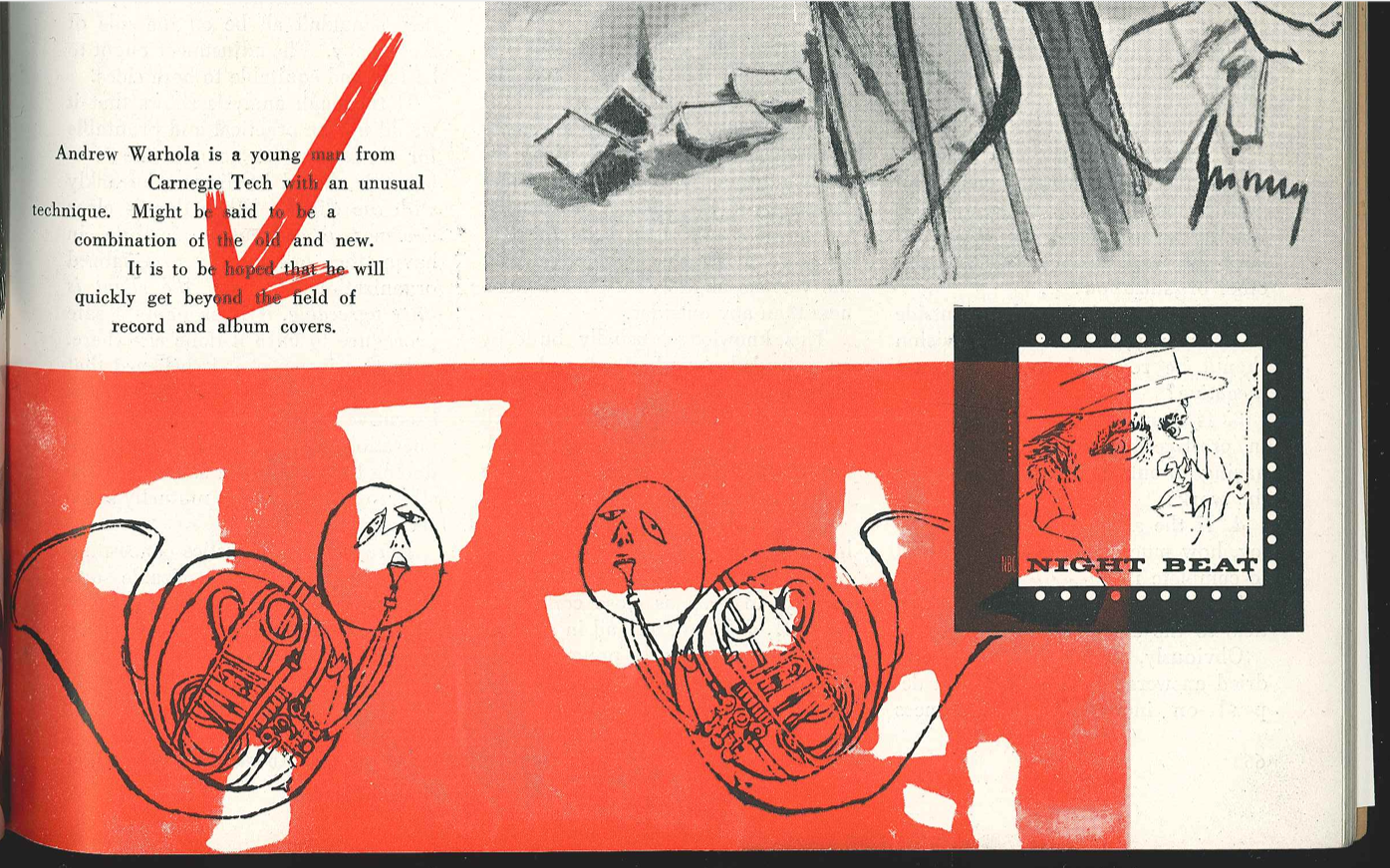
The NBC radio campaign was announced in a short article in the February 1950 issue of Variety, a trade magazine for the entertainment industry. Record boxes with a sales pitch and a complete radio show were sent out to companies and agencies in search for sponsorships.
The Night Beat boxset contains three 7” records, 45 rpm, on blue vinyl. Six sides are numbered EO-CX-342 through 347. The drama series stars Frank Lovejoy as newspaper reporter Randy Stone. Every night on the lookout for good copy in the city, Stone usually meets people in distress. He tries to help out whenever he can. The episode in the boxset is titled Zero. Randy Stone and a doctor’s secretary search the town to find a man who has suicidal thoughts, after learning from a medical report he is soon to die. But the secretary has made a big mistake: because she typed a 0 instead of 9 in his file number, the patient has received the wrong report. Date of broadcast of this episode was Monday February 6, 1950.
Here you can listen to the promo talk. And also listen to the full episode “Zero”.

I have in my collection an early version of the Night Beat drawing, in graphite. It is interesting to see that Warhol in 1949 was first using a different drawing technique, rather pointillistic, before switching to the blotted line style, as used in the final, more dramatic Night Beat drawing.
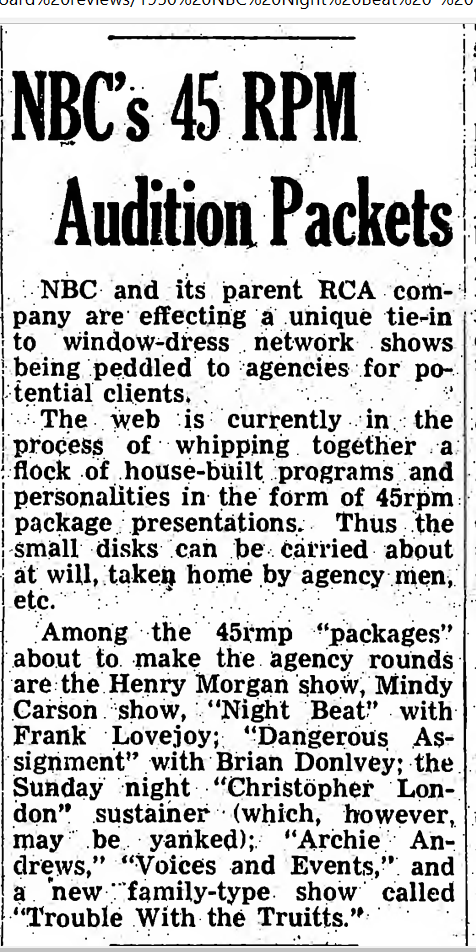
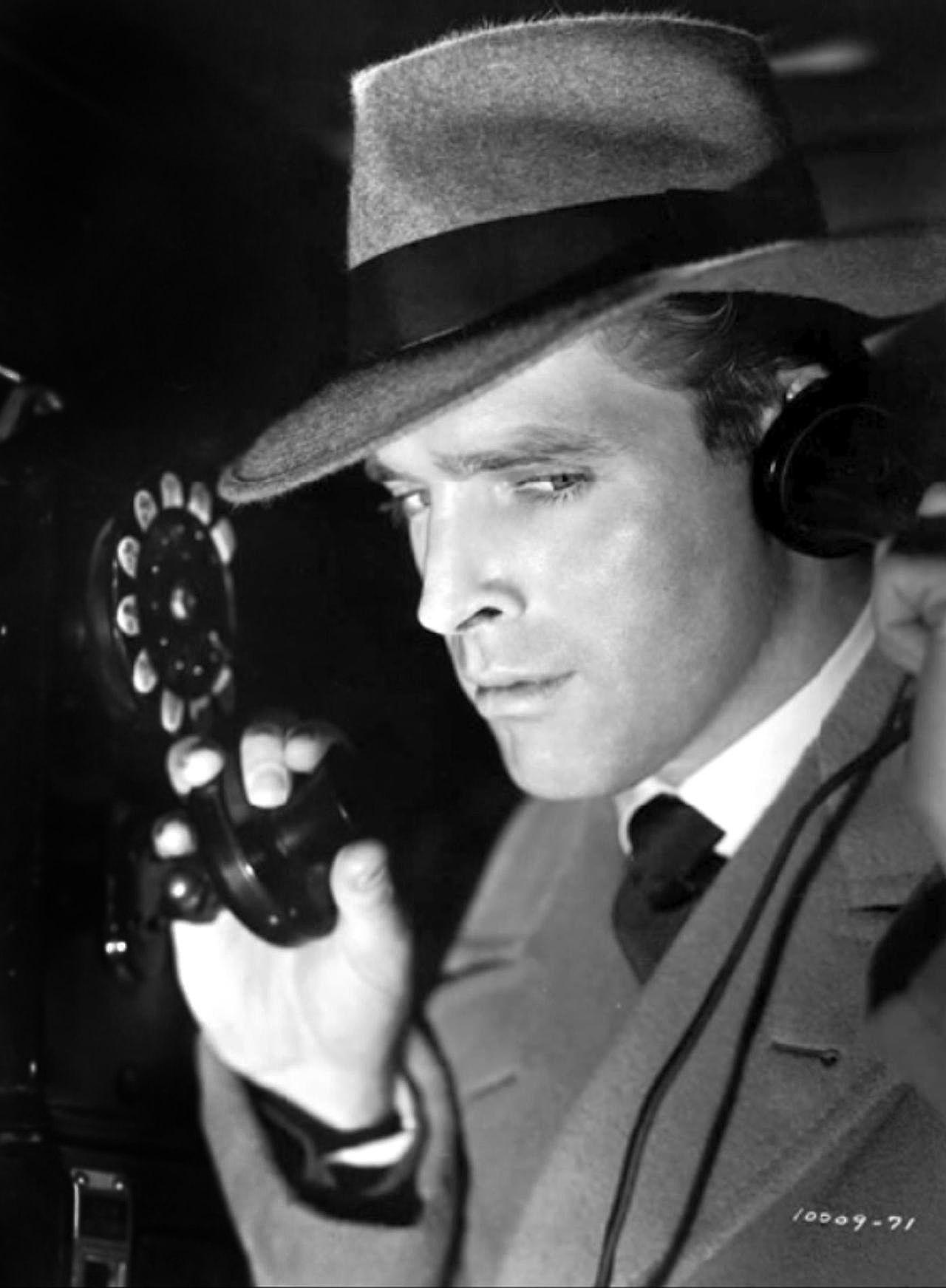
Warhol’s drawing was heavily based on a publicity image of Burt Lancaster in the film noir Sorry, Wrong Number, as seen in an ad in LIFE magazine, issue of October 25, 1948. The hat is quite clearly traced from this ad. LIFE magazine in the early Fifties was an important source for Warhol’s drawings.


The drawing on the Night Beat cover is a blotted line drawing, less pointillistic. Some elements were kept (the old type telephone, the nose, the mouth). The hat is different, and also the more paranoid eyes, looking as a man afraid he’s being followed. A typical image for film noir studio photos, in those days. Some staged studio stills of Burt Lancaster are in that style. Also on these pictures the older type of telephone is used, whereas in the film (and the poster ad) Lancaster was talking into a more modern telephone horn.

The cover of the Night Beat box, 1950.

Coming soon: a post on the Voices and Events box.


Fantastic, we always enjoy your research and very informative content
Kind regards
Ashley
Sent from my iPad
LikeLiked by 1 person
Thanks Ashley! Glad you appreciate my blog!
More coming soon.
Greetings from Belgium,
Guy
LikeLike
Hello Guy! Once again, “Thanks for another interesting and informative article. I appreciate your diligence and the expertly written narrative you provide. I continue trying to build my own collection, which unfortunately will probably never include “Night Beat”. I am however very proud of my VG+ copy of, “The Nation’s Nightmare”, which I acquired about 4 years ago for the astronomical price of …. $1. Also, “Thanks” for the recent information on “Al Escobar’s” Warhol covers. Keep up the good work my friend!
LikeLike
Congratulations, Guy! Another brilliant piece of research that places the Night Beat set much earlier than we had previously thought, suggesting that Andy had contacts with NBC/RCA at the same time he was doing the Columbia covers.
Blake Gobnik was right—you really ate the Sherlock Holmes of Warhol research!
LikeLike
Mooi om te lezen Johan
LikeLike
Pingback: Voices and Events: “This show is not just heard, it is listened to” | Andy Earhole
Great research, I have been collecting Warhol related record covers about ten years and I also have a very nice copy of the Nations nightmare and a collection on Discogs MrMax1 of about 60 + records! The info on Night Beat is great thanks for your hard work researching great info -regards Paul.
LikeLiked by 1 person