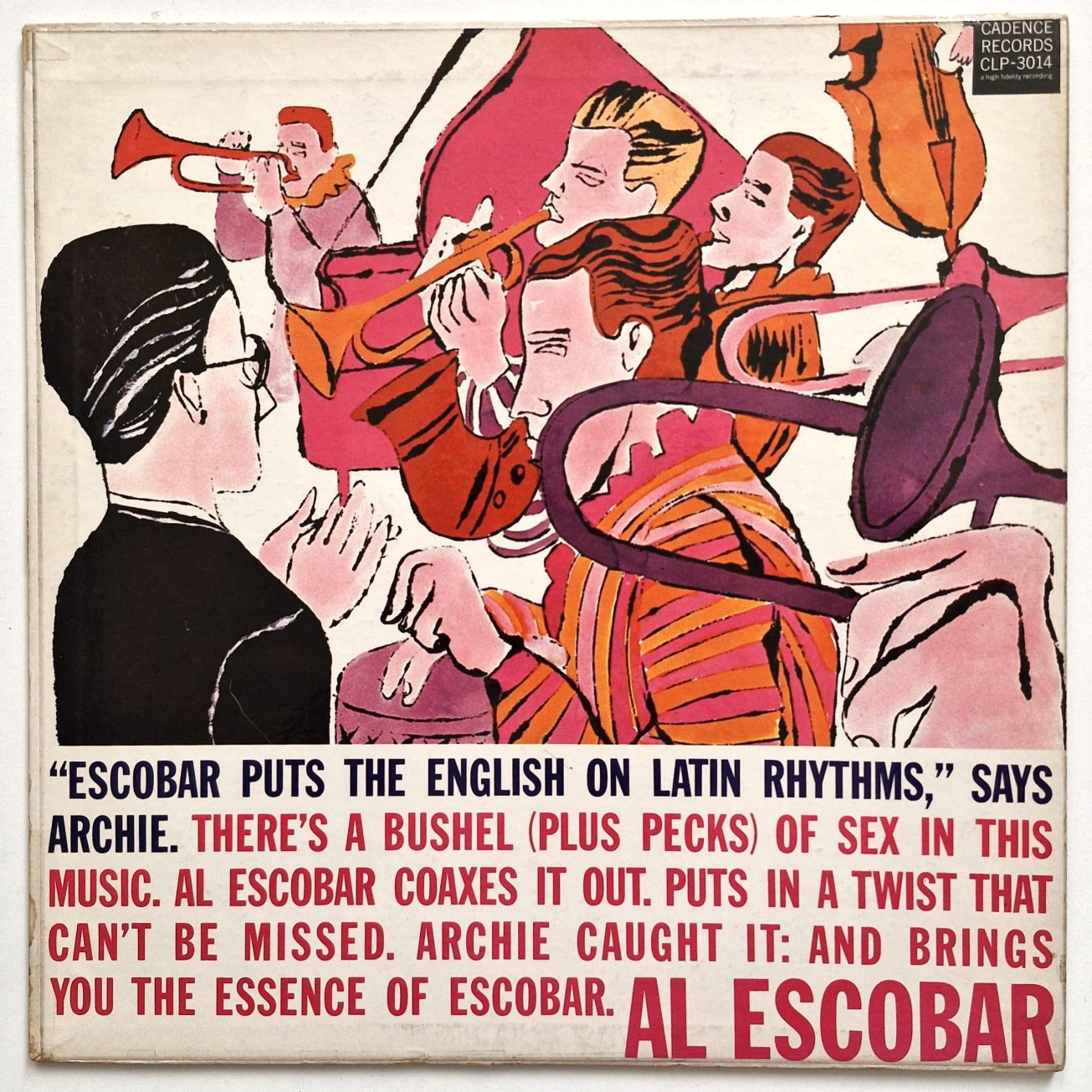
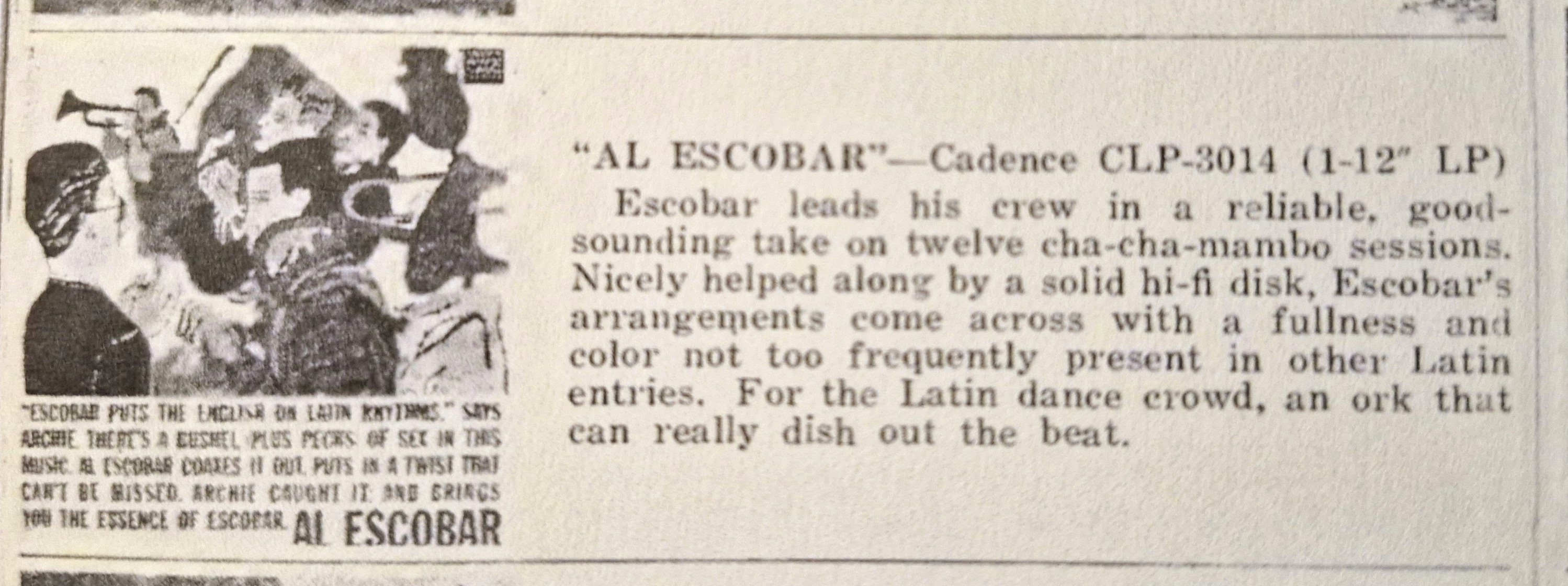
Thunderstruck. That word hardly describes what I felt when I first laid eyes on this mambo music album, a couple of weeks ago. Could it still be possible to discover a nearly 70 years old LP with undocumented Andy Warhol cover art? The answer is: Yes! And is it by any chance another collaboration with designer Reid Miles, of Blue Note and Prestige fame? Without a shred of doubt, it is. On top of that, the drawing in Warhol’s signature blotted line style turns out to be the most colourful and joyful illustration of all Warhol/Miles collabs, and even broader: of Warhol’s complete 1950ies album cover art output.
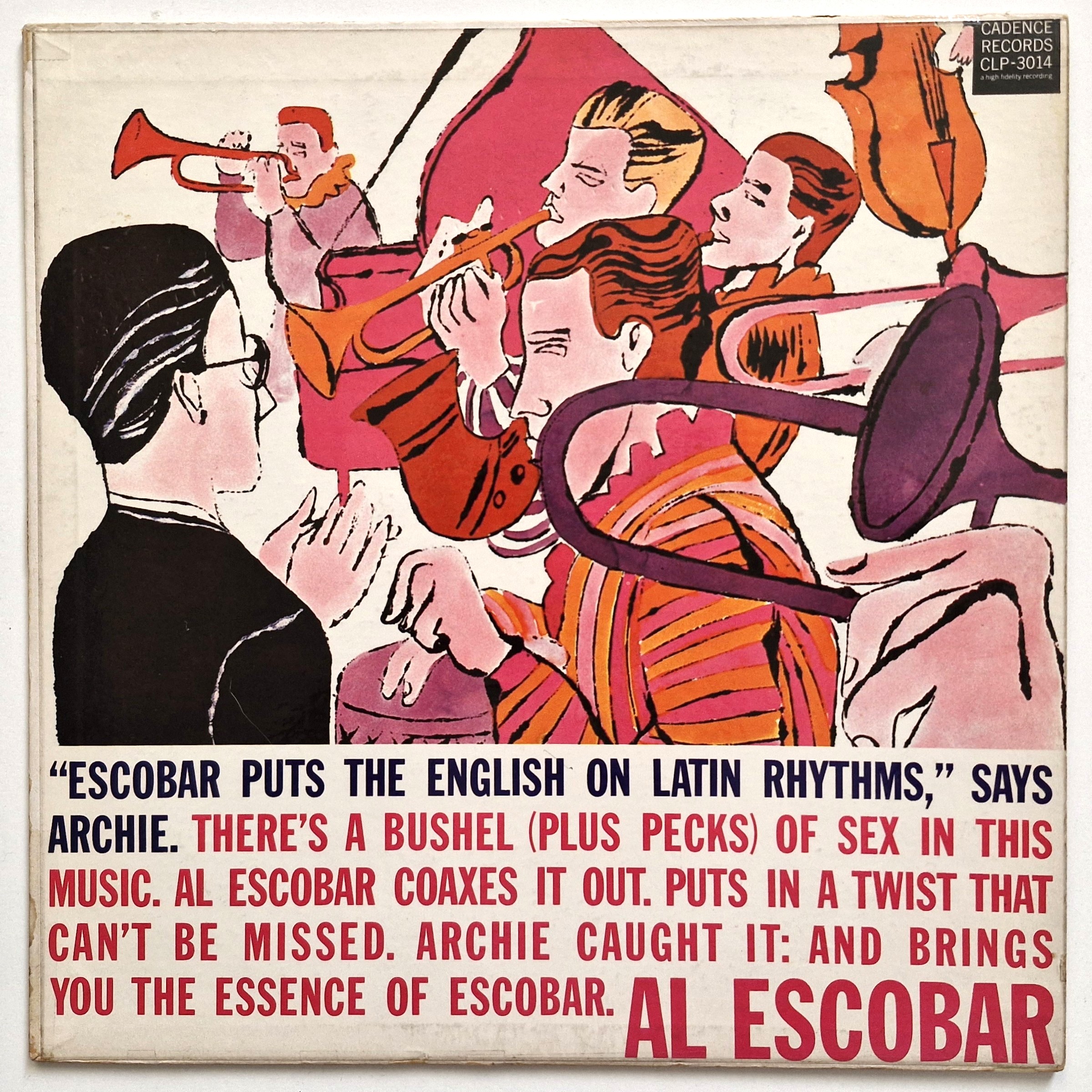
The album by Colombian pianist Al Escobar and his Afro-Cuban orchestra, which does not really have a title but rather a publicity text on the cover (which will be explained later on), was released in 1958 on Archie Bleyer’s label Cadence records, with catalogue number CLP-3014. On its labels the record is titled “Al Escobar Vol II”, as it is in fact the follow-up of the successful album Escobar’s Rhythmagic, released a year earlier on the same record label. On Discogs the album is listed as Rhythmagic Vol 2.
The LP cover will be on view in two important Andy Warhol exhibitions I am participating in, coming Summer:
– The exhibition Beethoven By Warhol in the Beethoven-Haus in Bonn, Germany, from September 9, 2026 until April 4, 2027
– Andy Warhol: From line to legend, at the Palace of Art (Pałac Sztuki), in Krakow, Poland, from August 6 until October 1, 2026
What lead me to the discovery, was an interview with Reid Miles in the book WAIL, The Visual Language of Prestige Records, by Chris Entwisle and Mark Havens, published at RIT Press in Rochester, in November 2025. A terrific book, the very first to thoroughly examine and describe the cover art of the Prestige jazz label. I am happy to say that I was able to contribute an image (the original ink drawing for the Trombone By Three cover, which I have in my collection) and information to the authors of the book. I will write a separate post about the book later.
In the chapter about Reid Miles, on page 213, Miles talks in an old interview about working with Warhol on record covers “because I could get a drawing from him for $25”, but also that Warhol pleaded at the advertising agency Hockaday Associates to give Miles a job. Turns out part of this job was doing record covers for “Archie Bleyer’s company Cadence records, which had the Everly Brothers. I did their first cover, the two of them on motorcycles.”
Because I had no idea how the cover of the first Everly Brothers album looked like, I took a dive in the cover art of Cadence records. And doing so found out about the existence of the Al Escobar album.
An article in the music trade magazine The Billboard, in October 1957, describes the connection between Hockaday Associates and Cadence records, and also explains the strange use of advertising slogans instead of titles. For instance “they’re off and rolling”, says Archie on the Everly Brothers album, or “he’s all male and catnip to quail”, says Archie on an Andy Williams album.
“‘New Look’ For Cadence Album Covers
NEW YORK – In a move to latch onto a different selling approach in today’s highly competitive album field, Cadence Records hired a new advertising agency, Hockaday Associates, heretofore associated with chi-chi ad campaigns for Capezio Shoes, Dunbar Furniture, etc.
Cognizant of recent criticisms – re lack of imagination in design, etc. – by the judging panel in The Billboard’s album cover contest (see The Billboard, July 29, ’57), Hockaday’s first job is to give Cadence’s album covers a “new look.”
In line with this, the agency is readying a group of covers designed to sell an LPs contents as an ad does in a magazine, utilizing a striking copy line instead of a title. The ad-type covers will be closely tied in – style-wise – with Cadence’s entire consumer advertising campaign.
The agency aims to have each album cover actually promote the record, on the theory that “the day of pretty, boffy, zoomy and zingy covers for the sake of zilch is no more.” In the same vein, Hockaday exec Joe Giardono states, “The album cover must be a corrugated salesman, every bit as selly as the paid ad.”
Cadence’s chi-chi cover campaign will be launched in January, via four new LP’s by the Chordettes. Andy Williams, Kenneth Patchen and the Chamber Jazz Sextette, and the Story Princess. The new cover psychology will also be applied to a group of new EP’s featuring the Everly Brothers, Williams, and the Chordettes.”
The Billboard, Oct 28, 1957, p22 & p31
Reid Miles is not named in the article, but it is safe to assume he was in charge of the design of this special CLP-3000 series. There are 12 albums in total with this cover concept, all released in 1958. Miles is mentioned in the 1959 yearbook of the Art Directors Club of New York, winning design prizes for two albums of this series (Marty Paich, CLP-3010; and The Sweet Adelines, CLP-3009). Credits in the yearbook were: Reid Miles (art director/designer); Hockaday Associates (advertising agency); Cadence Records (advertiser).
Funny detail is that record company owner Archie Bleyer’s presence on the album cover is not just in the “says Archie” quotes, where he personally promotes his artists. He also makes a Hitchcock worthy cameo on each and every cover: he is the man driving the Chordettes’ car, the man on the second motor cycle on the Everly Brothers album, the one man audience on the Kenneth Patchen album, the waiter on the Pal Joey album, and so on. In case of the Andy Warhol illustration of the Al Escobar album, Archie Bleyer is the man on the left, in black suit, joining the orchestra with hand clapping.
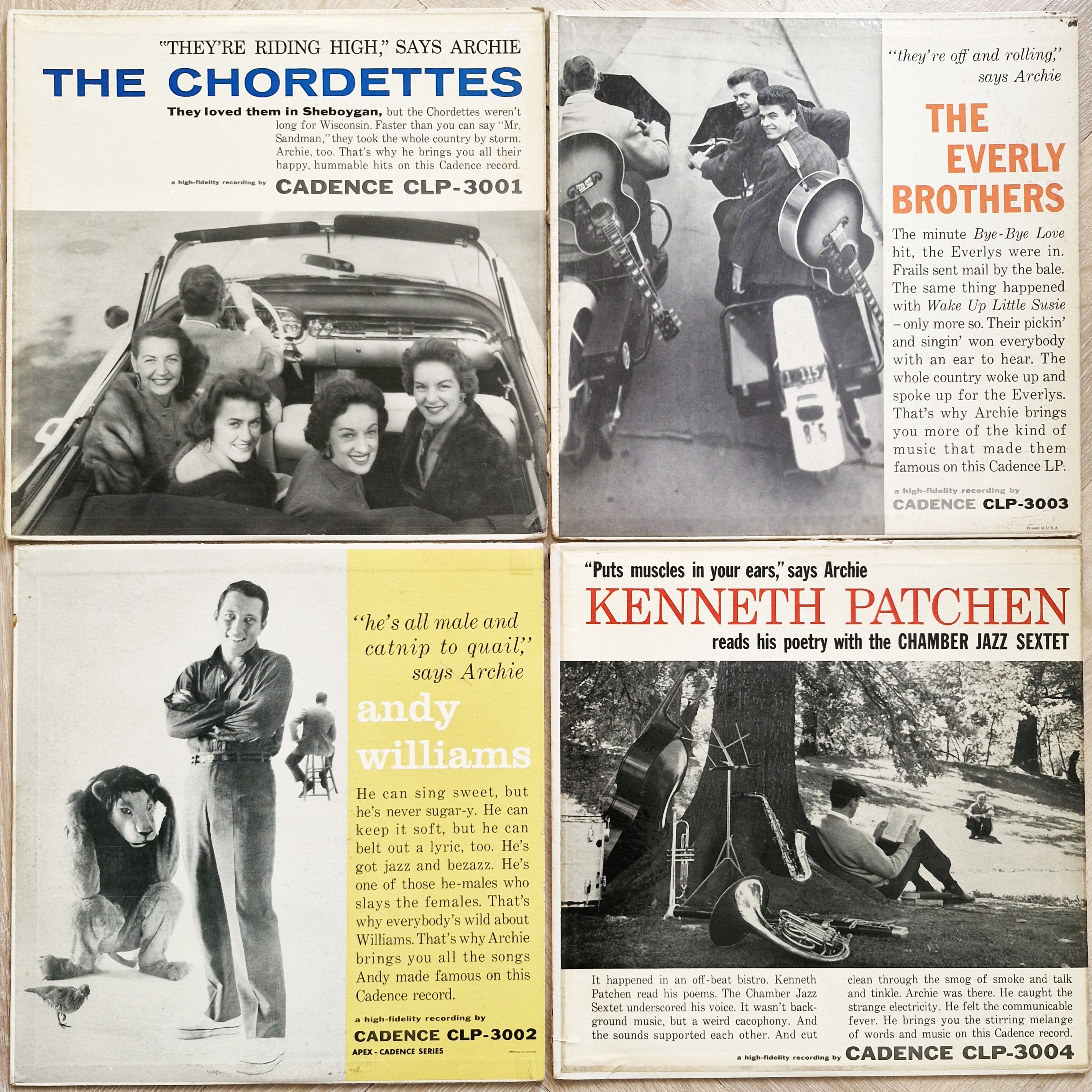
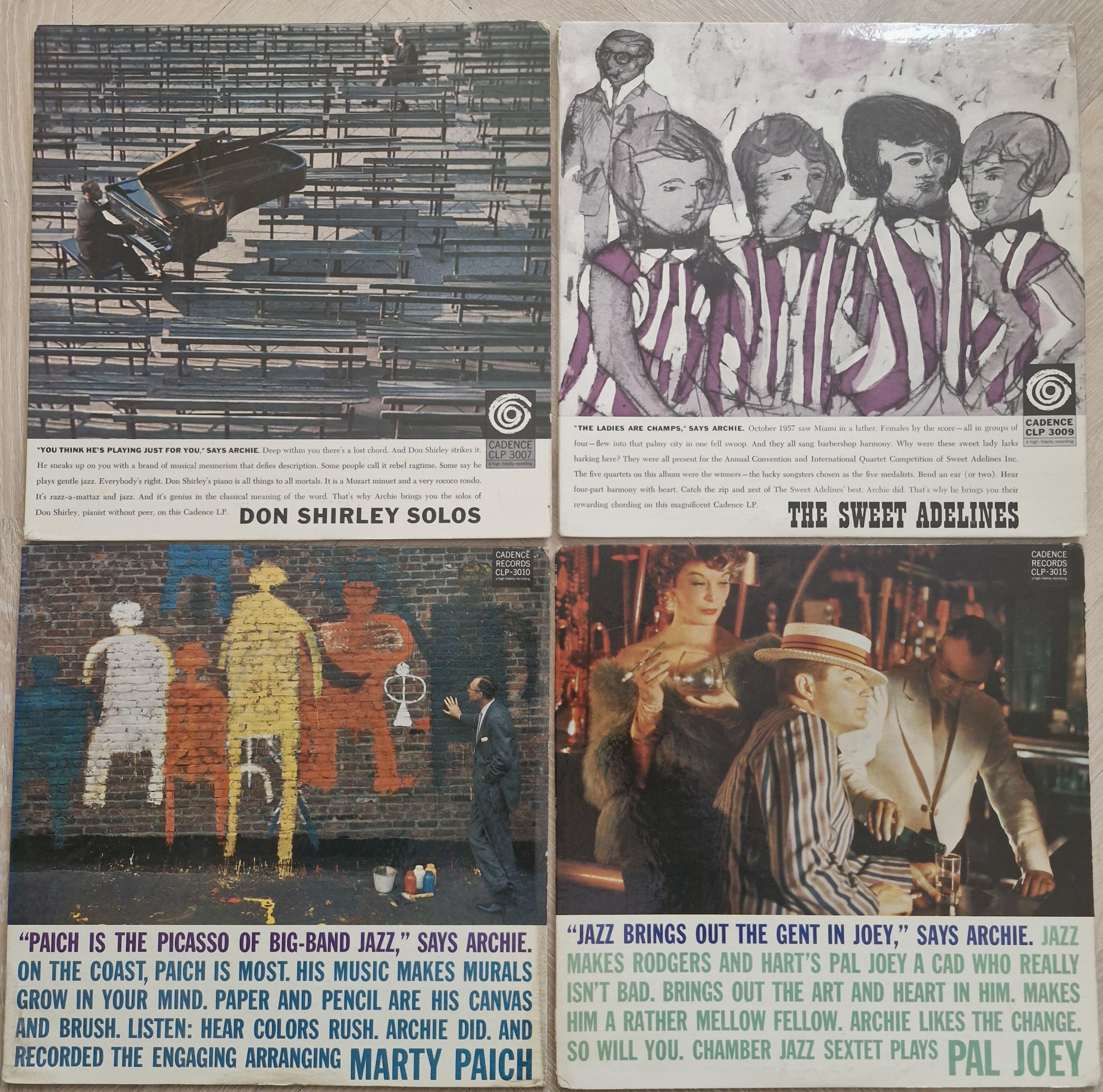
Complete list of Cadence albums with Says Archie quote and cameo, all released 1958:
CLP-3001 The Chordettes
CLP-3002 Andy Williams (first cover version)
CLP-3003 The Everly Brothers
CLP-3004 Kenneth Patchen
CLP-3005 Andy Williams Sings Rodgers and Hammerstein (first cover version)
CLP-3007 Don Shirley Solos
CLP-3008 Don Shirley with Two Basses
CLP-3009 The Sweet Adelines
CLP-3010 Marty Paich
CLP-3014 Al Escobar – with Andy Warhol cover illustration
CLP-3015 Pal Joey
CLP-4002 Lola Fisher – From Here To Yonder


What a great find, dear Guy!
Congrats,yours Stefan from Bonn
LikeLiked by 1 person
Thanks Stefan! Will look nice at the Beethoven by Warhol exhibition!
LikeLike
Another great find!! Congratulations, Guy.
LikeLiked by 1 person
Thanks Richard. It’s a beauty, isn’t it?
LikeLiked by 1 person
It really is! Quite unlike any other Warhol cover. The hunt is on.
LikeLiked by 1 person
It really is! Quite unlike any other Warhol cover. The hunt is on.
LikeLiked by 1 person
Great work! 👏👏👏🥂
Sent from my iPad
LikeLiked by 1 person
Dag Guy, Bedankt voor het mailtje over Rhythmagic Vol 2 ik zag op Discogs dat er 3 versies zijn 2 uit USA en 1 uit Canada de 2 uit US verschillenenkel in de beschrijving 1 is LP , Red en 2 is LP , Mono, Purple Weet je ook wat het vesrchil is tussen de 2 Misschien beetje rare vraag maar ik leer graag bij Groetjes Johan
LikeLiked by 1 person